

Process · September 2026
What a Flywheel Is and Why It Matters in Commercial Real Estate
How a repeatable process can improve industrial real estate decisions, execution and long-term results

A flywheel is a heavy, rotating wheel designed to store energy and smooth out uneven power. The basic principle predates modern industry and can be seen in early potter's wheels. By the 18th and 19th centuries, large flywheels had become important parts of steam engines and factory equipment, helping convert irregular bursts of power into steadier, more useful motion.
The reason it works is inertia. Energy is added by accelerating the wheel, and that energy remains stored as rotational kinetic energy while it spins. When incoming power drops, the wheel with its heavy mass only slows slightly, giving stored energy back while it maintains momentum. Modern flywheel systems use the same basic idea for applications ranging from engines and machinery to electrical energy storage.
The key characteristic is momentum. Getting a large flywheel moving takes effort. Once it is turning, however, each additional push builds on the motion already created.
From machinery to business
Jim Collins popularized the business version of this idea in the book Good to Great. His Flywheel Effect describes sustained progress as the result of repeated, reinforcing actions rather than one dramatic breakthrough. Collins later encouraged organizations to identify the specific components that make their own flywheel turn.
That idea helped me put words around something I was seeing in commercial real estate.
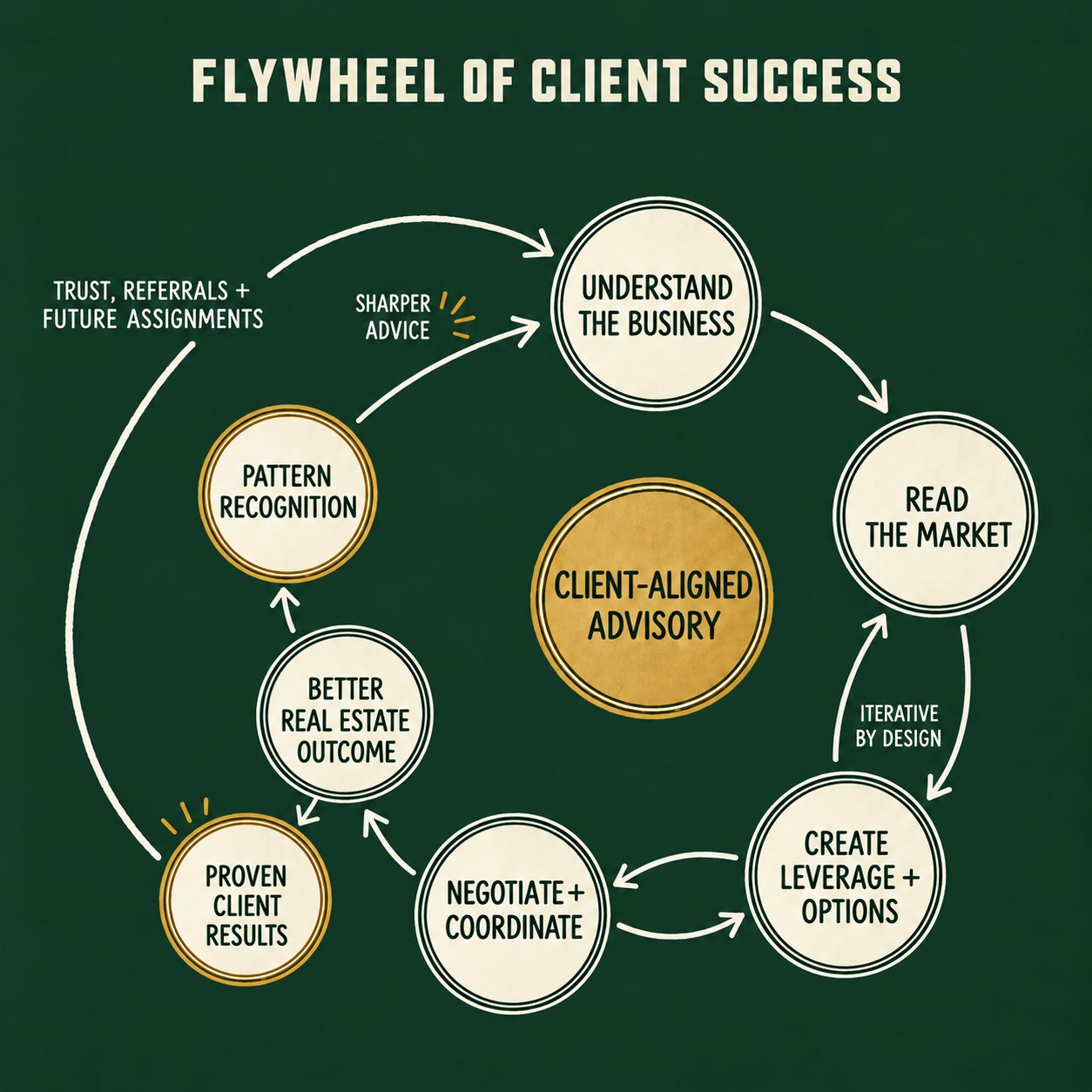
The Flywheel of Client Success
At the center of the flywheel is Client-Aligned Advisory. Every situation is different, but patterns emerge across markets and assets. The process begins by taking the time to Understand the Business: the client's goals, constraints, timeline and definition of a successful outcome. Once that mission is clear, we Read the Market, using relevant market data and real-world alternatives as a baseline or "North Star."
That market work helps us Create Leverage + Options. There are many formulaic ways to evaluate real estate decisions, but the real value comes from knowing which questions to ask, what alternatives are realistic, and which hard inputs are needed to compare them.
These first stages are Iterative by Design. Analysis often uncovers another question, a new constraint or a better opportunity that requires additional market work. The same iterative nature continues as we Negotiate + Coordinate: negotiating, marketing, coordinating due diligence and bringing in attorneys, lenders, contractors, architects or other specialists when needed. Staying flexible during execution matters because when a more valuable option surfaces, it needs to be weighed against the client's goals and the progress already made. Communication across the team becomes critical.
The negotiation and coordination ultimately exist to create a Better Real Estate Outcome, not simply to complete a transaction. That can mean different things in different situations: lower occupancy costs, better functionality, increased net operating income, reduced risk or a higher sale valuation.
Following a project, a better outcome can become Proven Client Results. We then look for Pattern Recognition: What worked? Which assumptions were wrong? What did the tenant, buyer, contractor or market teach us? Those lessons produce Sharper Advice on the next assignment. Over time, Proven Client Results also build Trust, Referrals + Future Assignments, which sends the flywheel back around to a new business and a new situation to understand.
A recent industrial transaction
A recent industrial sale assignment is a good example. It began broadly as a sale question: what can the building sell for in today's market? The owner was evaluating retirement, succession planning, and the tenants.
Market research established reasonable sales price and rental expectations compared to a vacant building sale for a new owner-occupier. Decision analysis connected those findings to a strategy and property valuation for the owner to consider. In a consultative and iterative process, we landed on a strategy to maximize exit value based on existing tenants. There were specific areas within the lease that opened the door to enhanced value, when weighing the profile of the tenant it made a less functional, older generation building more attractive in a rising vacancy submarket.
The full process of execution was not linear. Research improved the analysis when we ran into specific legal questions within the lease. Highly skilled vendors advised for an improved execution glide path, which resulted in a competitive bidding process and a close on the sale with no extensions during due diligence. In other words, we found value, which led to an attractive, low-risk close for the seller. The deal team learned valuable proprietary knowledge to help other sellers and tenants on future transactions.
That was the flywheel in action. Each assignment should do more than produce a closing. Done properly, it should create knowledge that makes the next decision better - and over time, word-of-mouth leads to new situations to analyze.